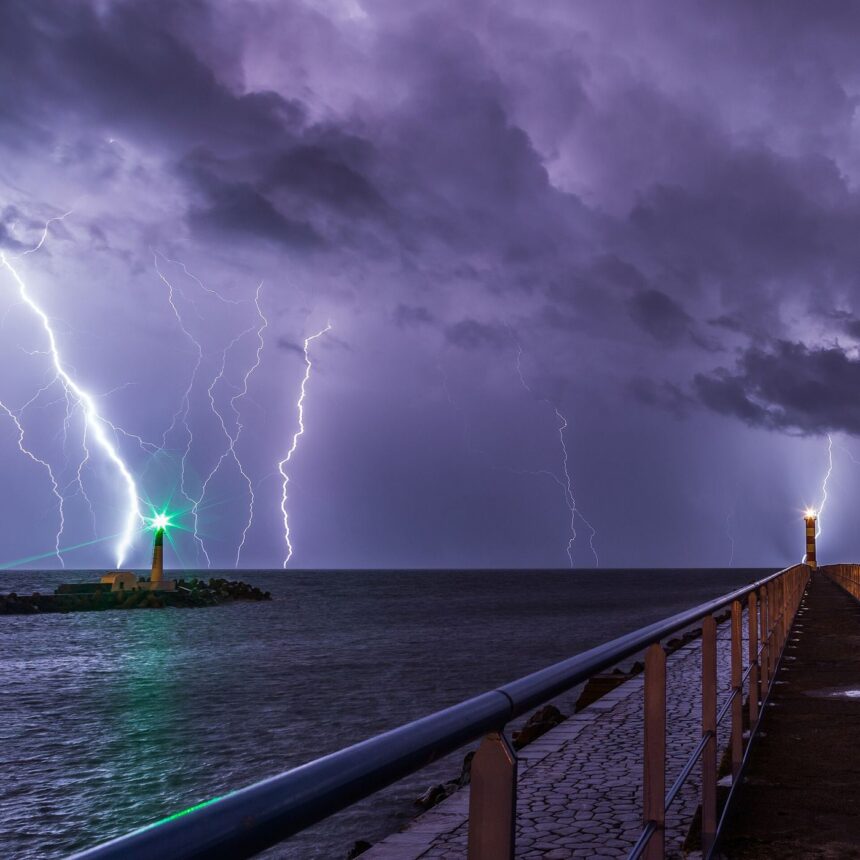
High-speed cameras filming hundreds of thousands of frames per second are revealing how lightning actually reaches the ground, step by invisible step. A flash begins with a faint, branching channel called a leader that feels its way downward from a thundercloud in short jumps, pausing between each advance. As it nears the surface, upward streamers rise from trees, buildings and other high points, competing to connect with the descending channel. The successful connection completes the circuit and triggers the brilliant return stroke that people perceive as the lightning bolt. Filming this sequence used to be impossible because the whole process finishes in a fraction of a second. Modern sensors, triggered automatically by electric field changes, now capture it routinely at research sites in storm-prone regions. The footage shows leaders splitting, recoiling and sometimes failing entirely, leaving the charge to try another path. Engineers study these details to improve protection for power lines, wind turbines, aircraft and tall buildings. Better understanding of where streamers form helps explain why some structures are struck repeatedly while nearby taller objects are spared.
What the Evidence Shows
The lightning leader footage is also refining basic physics that textbooks have simplified for decades. Measurements show leaders do not descend smoothly but lurch forward in steps roughly tens of metres long, with brief pauses while charge accumulates at the tip. Branches that fail to connect do not simply vanish; they can recoil and feed energy back into the main channel, influencing later strokes in the same flash. Researchers pair the cameras with radio receivers and current sensors on instrumented towers, building a complete picture from first breakdown inside the cloud to final current flow. That completeness matters for testing computer models used to design lightning protection standards worldwide. It also improves interpretation of the global lightning maps produced by satellites, which count flashes but cannot see their internal structure. Field campaigns remain weather-dependent and occasionally humbling, with expensive equipment waiting weeks for a cooperative storm. When a close strike is finally captured in perfect detail, however, a single flash can occupy analysts for months. Each recording turns a familiar spectacle into measurable evidence about one of nature’s fastest electrical processes. Reporting and analysis from sources such as NASA track the same developments, and specialists following the lightning leader footage say the direction is now consistent across independent lines of evidence.
The Wider Context
Funding bodies are watching the lightning leader footage closely because the work sits at the junction of basic curiosity and practical return. Grant panels increasingly ask for a path from discovery to application, while researchers push back that the most valuable uses of fundamental science are rarely the ones written into the original proposal. The tension is productive when both sides stay honest about timescales.
What Happens Next
The long view on the lightning leader footage is that fields advance by accumulation rather than by single announcements. This result adds a solid, checkable piece to a structure many teams are building, and its authors have shared their data so the piece can be tested from every side. That is how the picture eventually becomes reliable enough to act on. You can follow related developments in our coverage of science.
It is also worth remembering how quickly the picture in this area has changed before. Positions that looked settled a few years ago have been revised as new data arrived, and the same humility is appropriate now. The strongest coverage of this subject, and the most useful advice, tends to come from sources that update their views openly when the facts move, rather than defending an earlier position long after it has stopped fitting the evidence available.