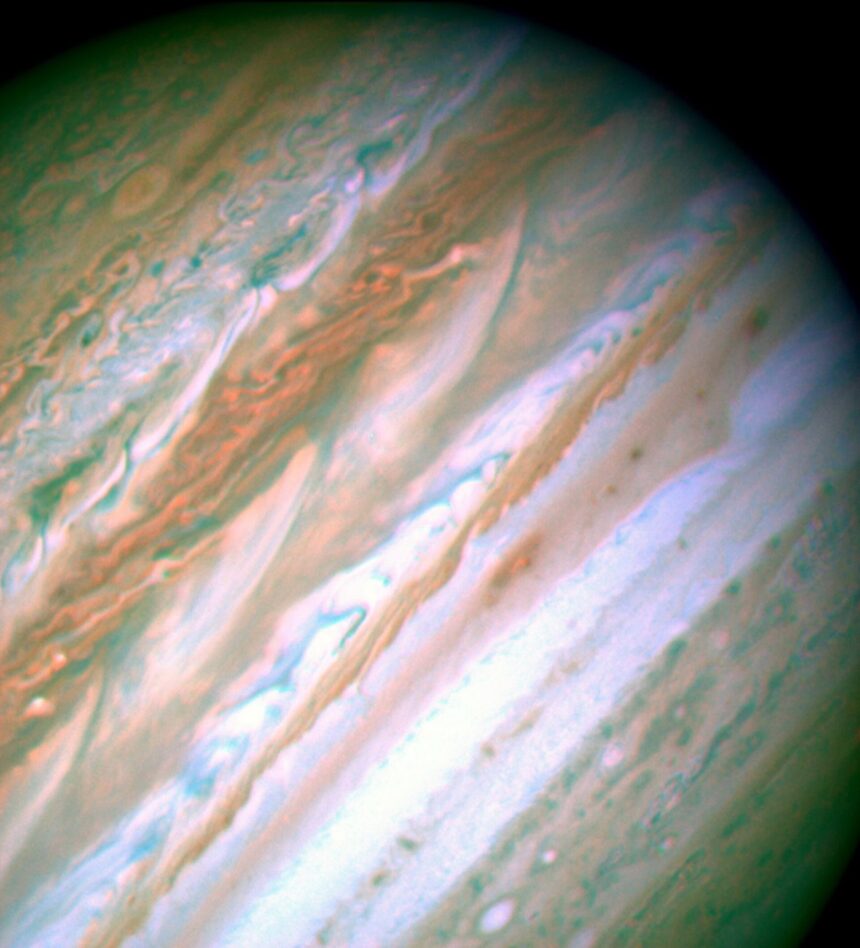
Beneath the cracked, icy shell of Jupiter’s moon Europa lies a global ocean that may hold twice as much water as all of Earth’s seas combined, and NASA has sent a spacecraft to find out whether it could support life. Europa Clipper, the largest planetary probe NASA has ever built, launched in October 2024 and is now on a long journey to Jupiter, where it is due to arrive in 2030. Once there, it will fly past Europa nearly fifty times, swooping as close as 25 kilometres above the surface to study the ice, the ocean below and the plumes of water vapour that may erupt from cracks in the crust. Its instruments will map the ice shell, measure the ocean’s depth and chemistry, and search for organic compounds, the chemical building blocks of life. The spacecraft carries nine scientific instruments, including ice-penetrating radar, cameras, a magnetometer and spectrometers, all designed to work together to build a complete picture of the moon and its ocean.
What the Evidence Shows
Europa is one of the most promising places in the solar system to look for life beyond Earth because it appears to have all three ingredients life needs: liquid water, the right chemical elements and an energy source. Heat from the flexing of the moon as Jupiter’s gravity tugs on it could keep the ocean liquid and drive hydrothermal vents on the sea floor, similar to the vents on Earth that support rich ecosystems in total darkness. Clipper will not land and cannot detect life directly, but it can determine whether the ocean is habitable, which would guide a future lander mission. The spacecraft must also survive intense radiation around Jupiter, which is why its sensitive electronics are shielded inside a protective vault. If the ocean proves habitable, Europa would move to the top of the list of worlds where life might exist today. The mission will also help scientists understand other icy ocean worlds, including Saturn’s moon Enceladus, which sprays water from its south pole, and could guide the search for life across the outer solar system. Reporting and analysis from sources such as NASA track the same developments, and specialists following Europa Clipper mission to Jupiter say the direction is now consistent across independent lines of evidence.
The Wider Context
Funding bodies are watching Europa Clipper mission to Jupiter closely because the work sits at the junction of basic curiosity and practical return. Grant panels increasingly ask for a path from discovery to application, while researchers push back that the most valuable uses of fundamental science are rarely the ones written into the original proposal. The tension is productive when both sides stay honest about timescales.
What Happens Next
The long view on Europa Clipper mission to Jupiter is that fields advance by accumulation rather than by single announcements. This result adds a solid, checkable piece to a structure many teams are building, and its authors have shared their data so the piece can be tested from every side. That is how the picture eventually becomes reliable enough to act on. You can follow related developments in our coverage of science.
It is also worth remembering how quickly the picture in this area has changed before. Positions that looked settled a few years ago have been revised as new data arrived, and the same humility is appropriate now. The strongest coverage of this subject, and the most useful advice, tends to come from sources that update their views openly when the facts move, rather than defending an earlier position long after it has stopped fitting the evidence available.